
A Republic in Distress
I’ve always loved this country. Not in the easy, flag-waving kind of way, but in the deeper sense. It’s the kind of love that compels you to confront its contradictions. The kind that doesn’t turn away when the story gets uncomfortable. The kind that asks: What are we becoming?
I write about America often, from its culture, its fractures, and its fading third spaces. More often than not, those writings never make it to the public eye. But behind every article, there’s always been a sense of faith. Faith that, for all its flaws, America still held onto something true: the promise of liberty, the sanctity of law, the idea that we are a nation governed not by men, but by principles.
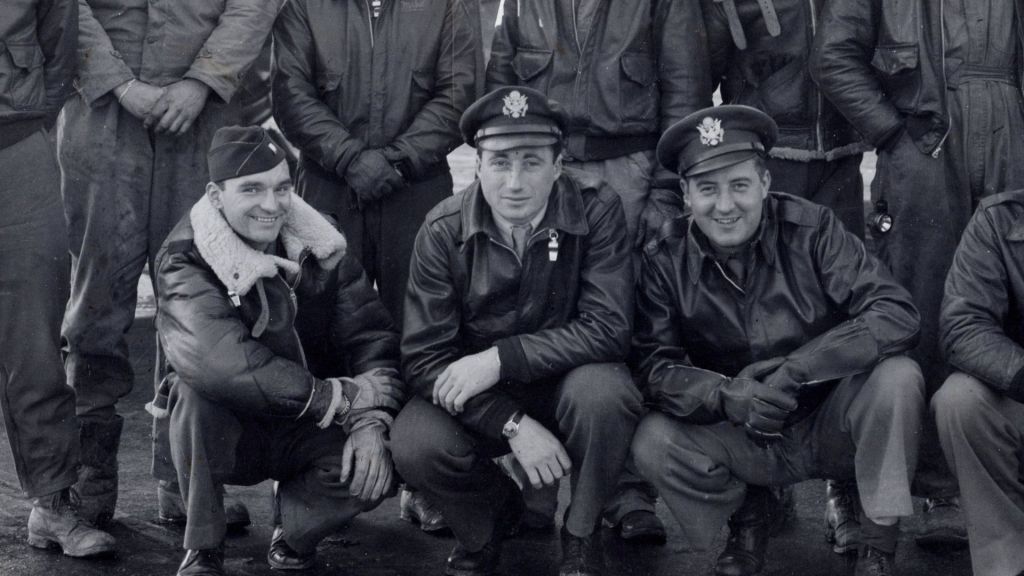
It’s the same faith that inspired my childhood heroes, people like Lieutenant Colonel Robert “Rosie” Rosenthal, a Jewish bomber pilot who flew into the heart of Nazi Germany and flew more missions than any other pilot in the 100th Bomb Group during World War II. He completed a total of 52 missions, despite the standard requirement of 25 missions for a tour of duty, and after his time in the service, he went on to be a lawyer during the Nuremberg Trials, interrogating and prosecuting those who had committed atrocious crimes against humanity.
To this day, he serves as a symbol of perseverance and dedication. He didn’t just fight fascism abroad. He believed in an America that would never allow it to take root here.
That’s the America I grew up believing in. And that’s the America I’m afraid we’re losing. The promise of America feels like it is unravelling.
In Los Angeles, ICE raids have sparked mass protests that are now spreading across the nation. These are not isolated enforcement actions; they are coordinated federal operations, often carried out in defiance of local officials. Mayor Karen Bass publicly opposed the raids. Governor Gavin Newsom filed legal action against federal overreach. Their objections have gone ignored.
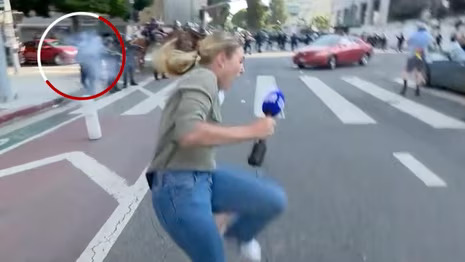
Over 2,000 National Guard troops and 700 U.S. Marines were sent into Los Angeles without state consent. The move was challenged in court. A federal judge denied a temporary injunction, effectively greenlighting the use of military force against civilians. Curfews were imposed. More than 450 people were arrested over the course of three nights. Press was obstructed, and in one instance, an Australian reporter was openly and purposely shot with a rubber bullet while displaying press credentials.
Similar scenes have unfolded in Chicago, New York, Atlanta, and Phoenix. Peaceful demonstrators and journalists have been met with aggressive crowd-control tactics typically reserved for wartime scenarios, from flashbangs, armored personnel carriers, kettling, and mass arrests. In New York, protestors gathering outside Trump Tower were forcibly dispersed. In Atlanta, immigration advocates were arrested on Buford Highway for failing to disperse, even after receiving no verbal warning. We would be here all day if we cited each and every instance.
This is not just policy run amok. While troops occupy American streets and press freedoms erode in real time, the Trump administration continues to issue sweeping executive orders that undermine the very foundations of the republic.
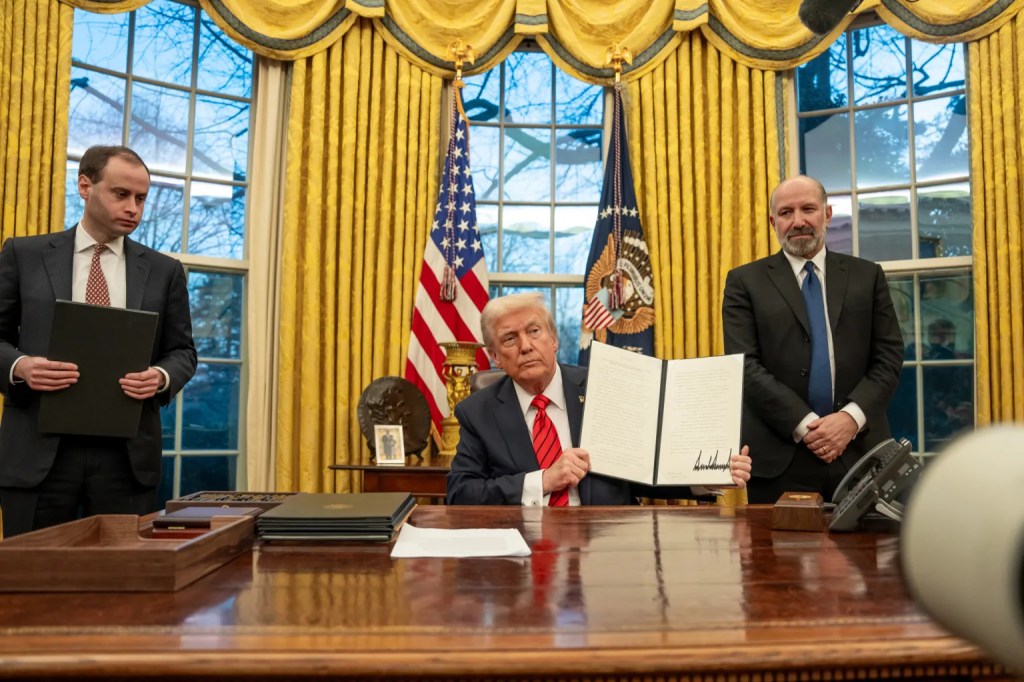
One such order attempts to strip birthright citizenship from children born in the United States to undocumented immigrants, a right enshrined in the Fourteenth Amendment since 1868. Though at least four federal judges have blocked its implementation, reports from immigrant legal advocates suggest that some DHS field offices are still treating these orders as active policy. Children who should be recognized as U.S. citizens by law are instead being subjected to detention or denied documentation altogether. The courts are clear, but the administration is moving forward anyway.
In another act, the president ordered the termination of more than 100,000 federal civil servants under the guise of efficiency and political loyalty. These are not partisan appointees, they include career scientists, environmental inspectors, food safety auditors, mine safety personnel, and public health officials. The firings have been challenged as a violation of the Constitution’s Appointments Clause and are now under emergency review by the Supreme Court. Yet the purge has already begun in multiple agencies, disrupting services millions of Americans rely on.
Then there is the direct assault on the public trust. An executive order to defund NPR and PBS was issued without Congressional input, effectively bypassing the legislature’s constitutional control over the federal purse. Lawsuits from multiple press freedom organizations are underway. In the meantime, long-standing grants for educational programming, rural broadcast stations, and public service journalism have been suspended. Critical infrastructure for civic information is being gutted, not through debate or legislation, but through unilateral decree.
Each of these moves would be alarming on its own. Together, they represent something far more dangerous: a coordinated dismantling of democratic safeguards. The executive is no longer checking power against the judiciary or collaborating with Congress; it is declaring itself the sole authority. And it is daring the rest of government to try and stop it.
It is in this context—military on city streets, courts defied, Congress bypassed—that we must examine something even more chilling: the normalization of propaganda.
This week, an image circulated online bearing the unmistakable seal of the U.S. government. It featured Uncle Sam putting up a call to action flyer, accompanied by the phrase: “Report All Foreign Invaders.” Below it was a hotline number for ICE. What makes this even more alarming is the fact that this image originated directly from DHS. Its visual language, bold lettering, and red-white-and-blue palette was designed to carry the authority of the state.
But more disturbing than its design was its message.
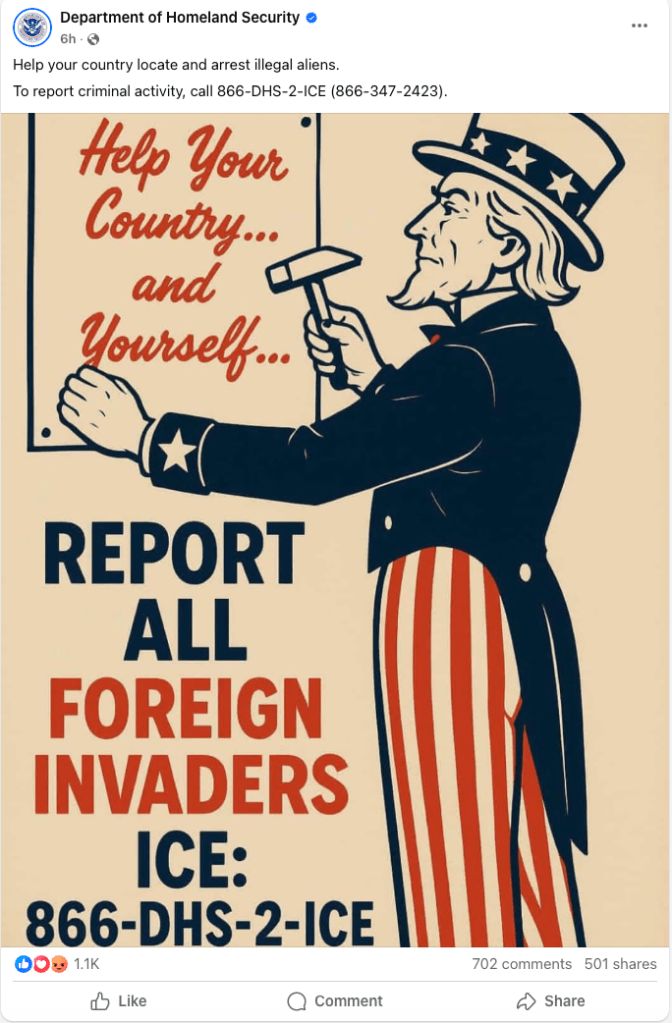
This isn’t a public safety alert. This is a psychological weapon. It reduces immigrants—people seeking work, refuge, or reunification with family—to the language of warfare. It invites citizens to surveil one another. It asks Americans to become informants. The phrase “foreign invaders” doesn’t just echo xenophobic talking points; it mirrors the rhetoric of past regimes that used fear of the outsider to justify the erosion of civil liberties.
In 1930s and 1940s Germany, posters declared Jews to be “enemies of the state,” “instigators of war,” and “threats to national purity.” They were often portrayed in caricature, with darkened features and hunched postures, much like the shadows and silhouettes used in today’s fear-driven media. The purpose was never merely to inform. The purpose was to dehumanize. To make persecution palatable. To prepare the public to accept, and eventually to participate in, systemic violence.
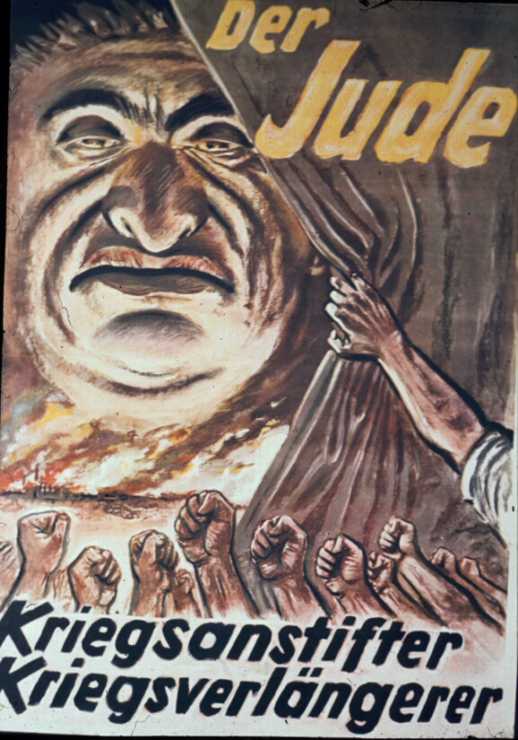
In Stalin’s USSR, similar tactics were used. The “saboteur” was the imagined internal enemy—an unfaithful worker, a foreign agent, a Jew, a teacher, a priest—anyone deemed inconvenient to the regime’s goals. State-sanctioned posters urged citizens to report them. Courts were reduced to formalities. Neighbors turned on neighbors.
Today, in America, we are not just watching that playbook being studied; we are watching it being enacted.
We see it in the militarization of civilian life. We see it in the criminalization of dissent. We see it in the language of invasion, infestation, and purity. And most of all, we see it in the slow conditioning of a public taught to fear—first the migrant, then the protester, then the press, then the judge.
If all of this feels familiar, it’s because history is not confined to textbooks or distant lands. The autocrat’s toolkit is well-worn, and it is being openly redeployed. The old saying is that history repeats itself. I disagree to some extent. History does not repeat, but it rhymes. And we are deep into the second verse.
In Hungary, Viktor Orbán began his rule with nationalist slogans and anti-immigrant rhetoric, eventually reshaping the judiciary, rewriting the constitution, and consolidating media under state-aligned ownership. Today, dissent there is marginalized not through brute force alone, but through legislative erosion and narrative control. It started with fear. It ended in one-party rule.
In India, Prime Minister Modi has similarly leveraged state power to marginalize Muslim minorities, politicize citizenship, and use state-aligned media to stoke communal hatred. Journalists have been jailed. Internet access has been cut off in dissenting regions. His party, once fringe, now dominates the landscape and is anchored by a cult of personality and a promise of restored national greatness.
In Brazil, Jair Bolsonaro targeted environmental activists, Indigenous communities, and journalists with such consistency that his administration normalized violence against civil society itself. Like Trump, he derided court rulings, mocked public health experts, and spread disinformation from the seat of government. Institutions weakened. Corruption thrived. The public was left divided and exhausted.
None of these regimes arrived overnight. They arrived slowly, legally, procedurally until the rules no longer applied and the memory of what came before had faded. Very rarely does an authoritarian regime take to power by force. More often than not, they are voted in.
That is what makes this moment in America so dangerous. We are not debating tax policy or foreign affairs. We are witnessing the corrosion of the very foundations upon which our democratic way of life is built. And still, the institutions that were designed to protect us—Congress, the courts, the media—are being tested beyond their limits. Some are holding. Others are not.
And the public? The public is overwhelmed, exhausted, distracted, or too frightened to believe it could actually happen here.
But it can. And It is.
And that is why we must name this moment for what it is: a democratic emergency and a Constitutional crisis.
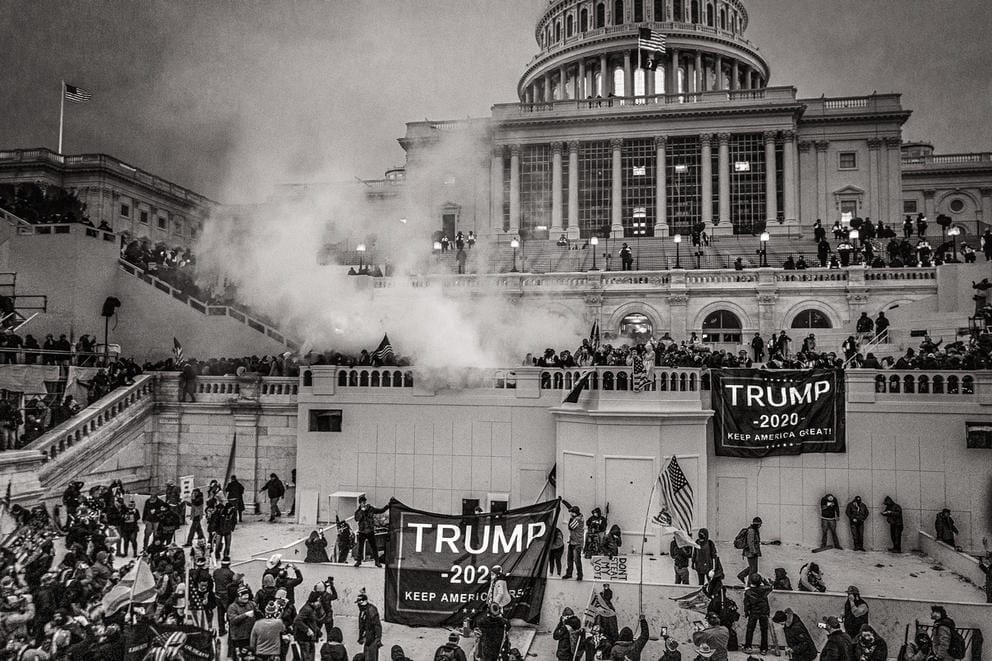
I’ve written before about the quiet erosion of connection in this country, about the loss of third spaces, the loneliness epidemic, the way digital life has replaced human community but this moment is different. This isn’t about disconnection. This is about something more sinister. This is about deliberate division. A national strategy built on fear and power, rather than unity and justice. And yet, I still believe in the America that inspired my heroes. The America that called Robert Rosenthal to fly mission after mission deep into Nazi territory not for glory, but because he believed that evil must be confronted. That truth mattered. That silence was complicity.
We are not at war. But we are being tested.
Tested on whether we’ll speak up when federal agents detain citizens for protesting.
Tested on whether we’ll look away when propaganda posters encourage neighbors to turn on neighbors.
Tested on whether we’ll tolerate a government that ignores the courts, guts public institutions, and silences the press.
Tested on whether we still remember that democracy is not a guarantee. It is a responsibility.
History will not be kind to those who stood by and watched.
It will not forgive the silence of people who claimed to love this country but said nothing as its core principles were dismantled.
So this is not just a call to awareness. It’s a call to courage.
Courage to speak when others stay quiet.
Courage to resist normalization.
Courage to say: this is not who we are, and we refuse to accept it.
Because if we fail to meet this moment with clarity and conviction, then we are not just losing a political battle.
We are losing the Republic.
 Call Me Taylor
Leave a comment